
A Self-Regulating Bio-Climate Adaptive Envelope Integrating Microbial Mineralization, Hygroscopic Hydrogels, and AI Optimization
Keywords:
Biomineralization, Hygroscopic hydrogels, Reinforcement Learning, Adaptive envelope, Microbially Induced Carbonate Precipitation (MICP), Building energy conservationAbstract
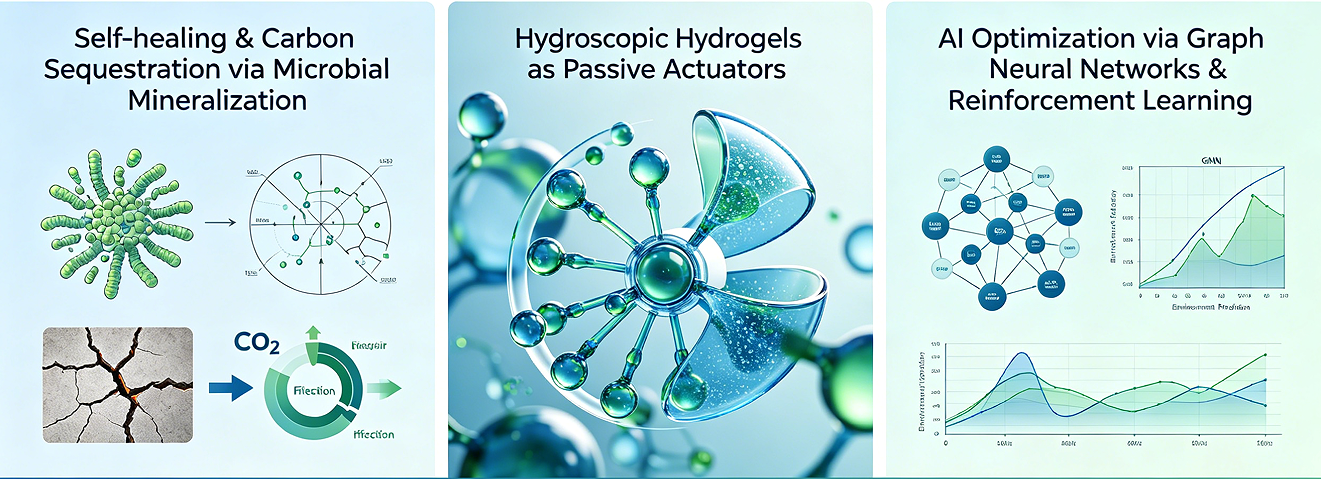
The building sector accounts for over one-third of global energy consumption and carbon emissions; consequently, traditional mechanical approaches to environmental control face increasingly severe sustainability challenges. This paper proposes the concept of a "bio-climate adaptive envelope"—a paradigm extending beyond conventional passive design—which integrates three key technological pillars: (1) Self-healing and carbon sequestration mechanisms based on microbial mineralization, leveraging the carbonate mineralization capabilities of ureolytic bacteria (e.g., *Bacillus* species) to achieve autonomous crack repair and biological CO₂ fixation; (2) Hygroscopic hydrogels serving as passive actuation elements, enabling energy-free ventilation regulation through humidity-responsive deformation at the molecular-rotor level; and (3) An AI optimization framework based on Graph Neural Networks and Reinforcement Learning, facilitating multi-scale prediction of indoor and outdoor environments alongside the coordinated management of biological processes. This paper systematically reviews the latest advancements in these technological domains, elucidates the coupling mechanisms between microbial metabolism and the water absorption-desorption cycles of hydrogels, and discusses critical challenges such as maintaining long-term microbial viability, ensuring cross-scale structural-biological stability, and conducting full life-cycle assessments. The research indicates that this integrated system holds the potential to reduce HVAC energy consumption by 30–50%, while simultaneously achieving a biological CO₂ fixation rate of 0.5–1.5 kg per square meter of facade per year. Finally, this paper proposes a new paradigm of symbiosis among architectural, environmental, and biological systems, providing a theoretical framework for the next generation of intelligent building technologies.
Downloads
Published
Issue
Section
License
Copyright (c) 2025 Advanced Interdisciplinary Science and Technology

This work is licensed under a Creative Commons Attribution 4.0 International License.