Edge Intelligence Empowering Primary Healthcare: A Review of Health Monitoring Systems for Resource-Limited Communities
Keywords:
Edge artificial intelligence, resource-limited settings, community health monitoring, health equity, triage systemAbstract
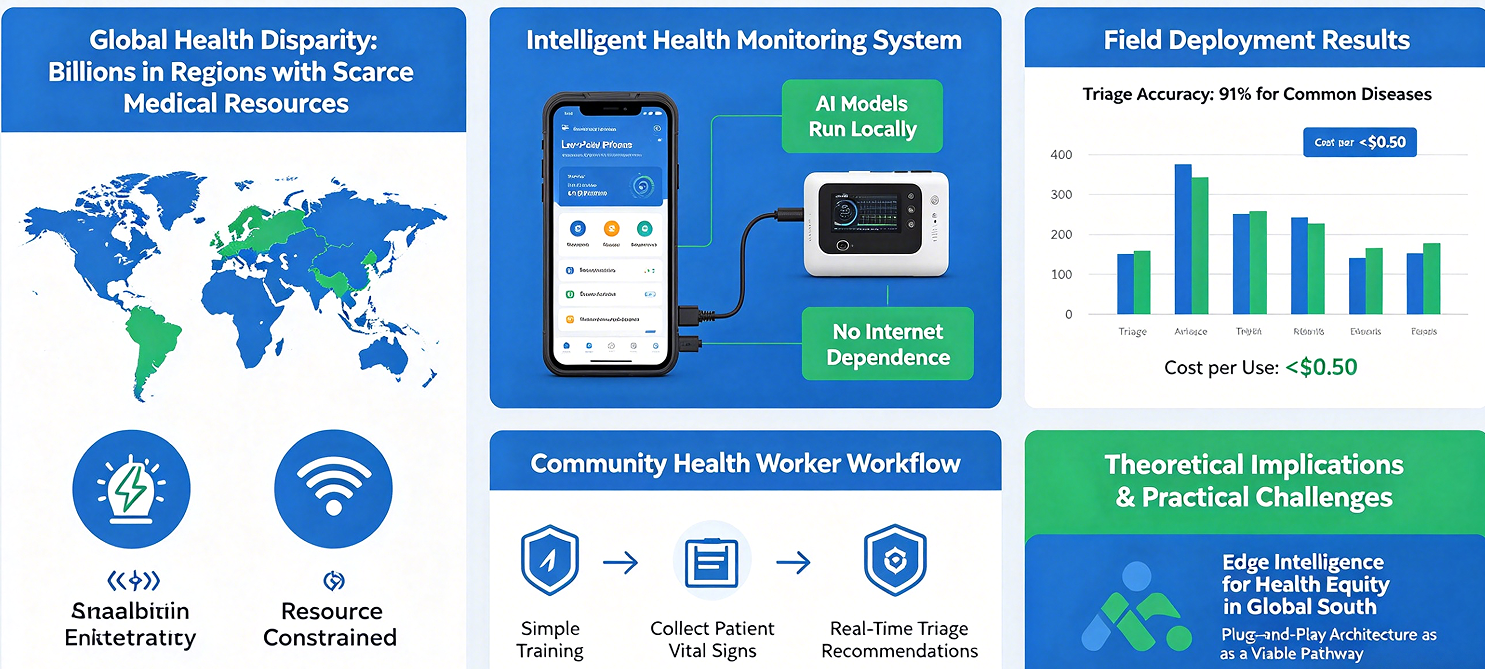
Approximately billions of people worldwide live in regions with scarce medical resources, where unstable electricity supplies and inadequate high-speed internet coverage render traditional telemedicine solutions unworkable. This paper systematically reviews recent advances in edge artificial intelligence (Edge AI) for health monitoring in resource-constrained environments, with a focus on the intelligent health monitoring system as a core case study. The system employs a modified low-cost smartphone paired with a portable multi-parameter sensor, with all AI models running locally on the device—completely eliminating dependence on internet connectivity. Following simple training, community health workers can collect patient vital signs, and the system provides real-time triage recommendations. In field deployments across rural Oman, the system achieved a preliminary triage accuracy of 91% for common infectious diseases and chronic conditions, with a cost of less than $0.50 per use. This paper further explores the theoretical implications and practical challenges of edge intelligence for health equity in Global South countries, proposing that a “plug-and-play” edge intelligence architecture represents a viable technological pathway to bridge the global health divide.
Downloads
Downloads
Published
Issue
Section
License
Copyright (c) 2026 Advanced Interdisciplinary Science and Technology

This work is licensed under a Creative Commons Attribution 4.0 International License.