
A Self-Regulating Bio-Climate Adaptive Envelope Integrating Microbial Mineralization, Hygroscopic Hydrogels, and AI Optimization
⭐ Review Article
Received: 10 March 2025 |
Revised: 16 March 2025 |
Accepted: 25 March 2025
Abstract
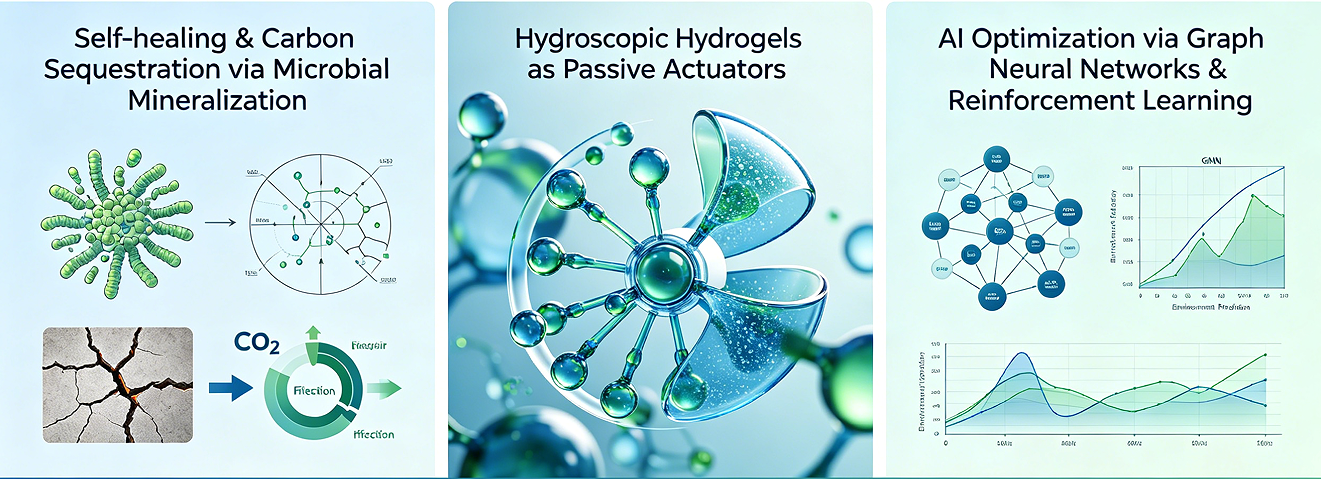
The building sector accounts for over one-third of global energy consumption and carbon emissions; consequently, traditional mechanical approaches to environmental control face increasingly severe sustainability challenges. This paper proposes the concept of a "bio-climate adaptive envelope"---a paradigm extending beyond conventional passive design---which integrates three key technological pillars: (1) Self-healing and carbon sequestration mechanisms based on microbial mineralization, leveraging the carbonate mineralization capabilities of ureolytic bacteria (e.g., Bacillus species) to achieve autonomous crack repair and biological CO₂ fixation; (2) Hygroscopic hydrogels serving as passive actuation elements, enabling energy-free ventilation regulation through humidity-responsive deformation at the molecular-rotor level; and (3) An AI optimization framework based on Graph Neural Networks and Reinforcement Learning, facilitating multi-scale prediction of indoor and outdoor environments alongside the coordinated management of biological processes. This paper systematically reviews the latest advancements in these technological domains, elucidates the coupling mechanisms between microbial metabolism and the water absorption-desorption cycles of hydrogels, and discusses critical challenges such as maintaining long-term microbial viability, ensuring cross-scale structural-biological stability, and conducting full life-cycle assessments. The research indicates that this integrated system holds the potential to reduce HVAC energy consumption by 30--50%, while simultaneously achieving a biological CO₂ fixation rate of 0.5--1.5 kg per square meter of facade per year. Finally, this paper proposes a new paradigm of symbiosis among architectural, environmental, and biological systems, providing a theoretical framework for the next generation of intelligent building technologies.
Keywords: Biomineralization; Hygroscopic hydrogels; Reinforcement Learning; Adaptive envelope; Microbially Induced Carbonate Precipitation (MICP); Building energy conservation
1 Introduction
The building sector accounts for 34% of global final energy demand and 37% of associated carbon emissions. Under the pressure of achieving net-zero emission targets, the traditional linear model of "construction--operation--maintenance" is facing fundamental scrutiny. While passive design strategies---such as natural ventilation, shading, and thermal mass---can partially reduce energy loads, they lack the capacity to actively respond to fluctuations in the external environment. Conversely, active HVAC systems, while capable of maintaining indoor thermal comfort, incur energy consumption and carbon emission costs that are becoming increasingly unsustainable. A fundamental paradigm shift is emerging: Can the building envelope be transformed from a "passive barrier" into an "active interface"---a system akin to biological skin that is capable of sensing environmental stimuli, autonomously regulating material exchange, and even possessing self-healing and metabolic capabilities? This vision is driving the rise of "bio-climatic adaptive architecture."
The central thesis of this paper is that, through the systematic integration of microbial mineralization techniques, hygroscopic hydrogel materials, and AI-driven optimization frameworks, it is possible to construct a truly "living" building skin. This skin would not merely respond passively to fluctuations in temperature and humidity, but would actively regulate indoor environmental quality while simultaneously achieving carbon sequestration and structural self-healing. This interdisciplinary integration transcends existing green building technology paradigms, opening up new possibilities for the symbiosis of architectural, environmental, and biological systems.
2 Technical Pillar I: Microbial Mineralization and Self-Healing Envelopes
2.1 Mechanisms of Microbially Induced Carbonate Precipitation
The application of microbial mineralization technology in the field of architecture centers primarily on "Microbially Induced Carbonate Precipitation" (MICP). The core of this process lies in harnessing the metabolic activity of specific microorganisms to alter the chemical equilibrium of the local microenvironment, thereby inducing the supersaturation and subsequent precipitation of calcium carbonate (CaCO₃).
Based on the degree to which microorganisms regulate the mineralization process, two distinct mechanisms can be distinguished: "microbially-controlled mineralization" and "microbially-induced mineralization." In the former, microorganisms actively sequester Ca²⁺ ions via negatively charged functional groups on their cell surfaces, thereby providing a template for crystal nucleation. The latter, conversely, relies on microbial metabolic products---such as the CO₃²⁻ ions generated by urease-mediated urea hydrolysis---to alter the chemical environment of the solution, thereby passively inducing precipitation.
Currently, the microorganisms employed for self-healing applications in concrete fall into four primary categories: ureolytic bacteria, aerobic respiratory bacteria, carbonic anhydrase-producing bacteria, and nitrate-reducing bacteria. Among these, the genus Bacillus (specifically B. pasteurii and B. subtilis) has emerged as the most extensively studied and widely applied group, owing to its spore-forming capabilities, tolerance to extreme environmental conditions, and the availability of complete genomic data.
2.2 Engineering Implementation of Self-Healing Concrete
The implementation pathways for microbial self-healing concrete can be broadly categorized into "passive healing" and "intrinsic healing." The former involves applying microorganisms or enzyme preparations to the concrete surface, thereby providing a healing effect solely for surface-level cracks. The latter, conversely, entails pre-embedding microbial spores and nutrients within the matrix material; these agents are activated upon crack propagation, enabling autonomous healing at deeper structural levels.
A critical challenge lies in ensuring the long-term survival of microorganisms within the highly alkaline environment (pH > 12) characteristic of cement-based materials. Existing solutions include: utilizing alkali-resistant bacterial spores; pre-encapsulating microorganisms within porous carriers (such as expanded clay, diatomaceous earth, or activated carbon); and reducing localized pH levels through stratified curing techniques. Research indicates that optimally designed self-healing concrete can increase the effective crack-healing width from 0.3 mm to over 0.8 mm, while simultaneously reducing the chloride ion permeability coefficient by 24--31%.
2.3 Facade-Scale Applications and Carbon Sequestration Potential
Extending microbial mineralization technology from structural concrete elements to building facades has paved the way for a novel architectural concept: the "photobioreactor facade." In this system, microalgae (e.g., Chlorella vulgaris) are continuously cultured within the transparent interlayers of a facade structure; through photosynthesis, they sequester CO₂ while simultaneously providing dynamic solar shading and thermal buffering. A microalgae retrofit project on the western facade of the Centre Pompidou in Paris has demonstrated that this strategy significantly outperforms urban tree planting in terms of carbon sequestration efficiency per unit area.
Simulation studies suggest that, under temperate continental climatic conditions, a microalgae facade system can achieve an annual CO₂ sequestration rate ranging from 84.87 kg to 770.13 kg (depending on facade area and culture density), while simultaneously satisfying over 50% of the required daylight illumination levels. However, the system currently struggles to fully offset the building's operational energy consumption, and its investment payback period extends to 16--24 years; consequently, widespread commercial adoption necessitates further breakthroughs on both technical and economic fronts.
3 Technical Pillar II: Hygroscopic Hydrogels as Passive Actuation Elements
3.1 Mechanism of Humidity-Responsive Deformation
If microbial mineralization endows buildings with the capabilities of "metabolism" and "self-repair," then hygroscopic hydrogels bestow upon them the abilities to "sense" and "act"---a passive actuation mechanism requiring no external energy input. The humidity-responsive deformation of hydrogel materials stems from the reversible adsorption of water molecules by hydrophilic functional groups within their polymer networks: the network expands as humidity rises and contracts as humidity falls.
Recent research has overcome the traditional limitations of hydrogels---namely, slow response times and low mechanical strength. The JNU-hygroCOF dynamic covalent organic framework (COF) film achieves nanoscale humidity response speeds and centimeter-scale bending deformation by regulating the open/closed states of its molecular rotors (N--N bonds). This "molecular lock" mechanism triggers a conformational transition within the material upon the absorption of water molecules, directly converting chemical potential energy into mechanical work; this results in an energy conversion efficiency that is more than an order of magnitude higher than that of traditional hydrogels.
3.2 Wood-Based Bilayer Actuators and Climate-Responsive Ventilation
By laminating a hygroscopic material onto an inert substrate layer, a "bilayer actuator" can be constructed: changes in humidity induce differential expansion between the two layers, generating predictable bending deformation. Wood serves as an ideal choice for such bilayer actuators due to its natural hygroscopic anisotropy, low cost, and renewability.
The "elastic kinetic coupling" strategy proposed by Elmqvist et al. achieves a mechanical amplification of deformation amplitude by integrating wood-based bilayer actuators with spring mechanisms. This mechanism draws inspiration from the "catapult" motion principles observed in carnivorous plants: the actuator slowly accumulates strain energy until reaching a critical threshold, at which point it releases the energy rapidly to achieve a displacement several times greater than that produced by passive expansion alone. Integrating this mechanism into roofing tile systems allows for the creation of entirely passive "climate-responsive vents": these vents automatically open when humidity rises to facilitate convective heat dissipation, and close when conditions become dry to maintain airtightness.
3.3 Potential for Coupling with Microbial Systems
The coupling of hydrogels with microbial systems represents one of the core innovations proposed in this paper. This coupling can be realized through two pathways: first, during the water absorption phase, the hydrogel captures atmospheric moisture, thereby providing a liquid-phase microenvironment conducive to microbial metabolism; second, during the water release phase, the hydrogel releases its stored moisture, driving the transport of nutrients toward the microbial community. Together, these processes establish a synergy between a "hygric cycle" and a "nutrient cycle," forming a low-energy, self-sustaining ecosystem.
4 Technical Pillar III: AI-Optimized Coordinated Management
4.1 From Passive Response to Predictive Control
The aforementioned microbial and hydrogel technologies endow the building envelope with "sensing-actuating" capabilities; however, the spatiotemporal scales of these processes differ vastly: hydrogel response times range from seconds to minutes, whereas microbial mineralization and growth occur over hours to days. How, then, can these heterogeneous processes be coordinated to achieve optimal system-level performance? This constitutes the critical juncture at which artificial intelligence (AI) intervenes.
Traditional building control systems rely on setpoint-based logic, rendering them ill-equipped to handle non-steady-state environmental fluctuations and the complexities of occupant behavior. Reinforcement Learning (RL) methods---which derive optimal strategies through trial-and-error interactions---have demonstrated significant advantages in the field of HVAC control in recent years. The "Topology-aware Hypergraph Q-Network" proposed by Zhong et al. encodes the building's spatial topology as a hypergraph, enabling the intelligent agent to comprehend the thermal coupling relationships existing between different zones. Experimental results, validated against real-world office data, indicate that this method achieves a 21.1% improvement in energy efficiency and a 20.9% reduction in occupant dissatisfaction rates.
4.2 Multi-Scale Prediction and Coordinated Management
An AI framework designed for bio-climatically adaptive building envelopes must address coordination challenges across three distinct levels: (1) Temporal Coordination---integrating the rapid deformation dynamics of hydrogels with the slower metabolic processes of microorganisms into a unified state-space model; (2) Spatial Coordination---jointly optimizing the localized microenvironments of the building façade (e.g., light intensity, humidity) with the overall thermal comfort of the interior space; and (3) Resource Coordination---identifying a Pareto-optimal balance among nutrient supply, water distribution, and solar shading control. The HVAC-GRACE framework proposed by Berkes et al. provides the methodological foundation for this approach: it models the building as a heterogeneous graph, where Graph Neural Networks (GNNs) facilitate information propagation across spatial dimensions, while Gated Recurrent Units (GRUs) capture dynamic changes across temporal dimensions, thereby enabling zero-shot transfer capabilities to previously untrained buildings. This conceptual framework can be extended to bio-climatic systems: microbial culture modules and hydrogel arrays can be viewed as graph nodes, with the flows of matter and energy between them serving as edges; a Graph Reinforcement Learning agent then orchestrates globally optimal, coordinated management by regulating micro-valves and shading systems.
5 System Integration: Towards Living Building Envelopes
5.1 The Collaborative Logic of the Three-Layer Architecture
Integrating the three aforementioned technologies into a unified system necessitates the construction of the following three-layer architecture: Perception Layer: An IoT sensor network monitors indoor and outdoor temperature and humidity, CO₂ concentration, light intensity, and microbial activity metrics. Actuation Layer: Hydrogel bilayer actuators drive the opening and closing of ventilation vents; microalgae/bacterial culture modules facilitate carbon fixation and crack remediation; and micro-valves regulate the distribution of nutrients and water. Coordination Layer: A Graph Reinforcement Learning-based AI agent generates control commands, optimizing for objectives such as indoor thermal comfort (measured via PMV/PPD indices), energy consumption (kWh/m²), and carbon fixation capacity (g CO₂/m²/day). The key innovation of this architecture lies in treating microbial metabolism as a "dispatchable resource" rather than mere background noise. During periods of low demand, the system can reduce nutrient supply, inducing the microbes into a dormant state to conserve resources; conversely, during periods of high demand or in the event of structural cracking, the system actively triggers a microbial response. This "demand-responsive bio-management" represents a frontier that has yet to be systematically explored within existing technological landscapes.
5.2 Sustainable Material Cycle Design
The long-term autonomous operation of the system relies on a closed-loop material cycle. Ideally, the moisture adsorbed by the hydrogels from the indoor and outdoor air serves a dual purpose: a portion is utilized to maintain the optimal concentration of the microbial culture medium, while the remainder facilitates evaporative cooling to lower the surface temperature of the building envelope. The biomass (microalgae) generated through microbial photosynthesis can be harvested and subsequently converted into biofuels or fertilizers, thereby offsetting the system's operational costs. The products of biological CO₂ fixation---specifically calcium carbonate---are deposited directly within micro-cracks; this process simultaneously achieves structural self-healing and the permanent sequestration of carbon.
6 Key Challenges and Research Frontiers
Although the concept of bio-climate adaptive building envelopes is highly compelling, its practical engineering implementation still faces numerous challenges.
Maintaining Long-Term Microbial Activity: The high alkalinity of cement-based materials, coupled with drying-wetting cycles and temperature fluctuations, poses a persistent threat to microbial survival. While spore dormancy strategies can extend survival periods, the issue of declining activation rates over time remains unresolved. Future research directions include: developing genetically engineered microbial strains to enhance stress resistance, and designing biomimetic "microbial shelters" (e.g., 3D-printed multi-scale porous structures) to buffer against environmental fluctuations.
Cross-Scale Structural-Biological Stability: The expansion-contraction cycles of hydrogels can exert periodic mechanical stress on the surrounding matrix, potentially triggering microscopic fatigue cracking under long-term exposure. Although microbial mineralization processes can partially repair such damage, the relationship between the rate of repair and the rate of damage accumulation remains unclear. It is necessary to establish multi-scale mechano-biological coupling models to predict the service life of the system.
Life Cycle Assessment: Existing studies tend to focus primarily on energy savings during the operational phase, while paying insufficient attention to embodied carbon and costs. Preliminary estimates suggest that the payback period for microalgae facades could range from 16 to 24 years; furthermore, the carbon footprint associated with producing the nutrients required for microbial cultivation (particularly nitrogen sources) may partially offset the carbon sequestration benefits realized during the operational phase. There is an urgent need to conduct comprehensive life cycle assessments and multi-objective optimization studies encompassing technical, economic, and environmental factors.
Reliability of the Sensing-Control Closed Loop: The inherent uncertainty of biological processes poses a formidable challenge to the robustness of AI-based controllers. Microbial growth rates are influenced by the coupled effects of multiple factors, and errors in predictive models may accumulate over time. It is necessary to introduce frameworks such as Bayesian reinforcement learning or Robust Model Predictive Control (Robust MPC) to quantify and manage this uncertainty.
7 Outlook: A New Paradigm for the Symbiosis of Architectural, Environmental, and Biological Systems
This paper systematically demonstrates both the theoretical feasibility and the preliminary technical maturity of "bio-climate adaptive building envelopes"---systems that integrate microbial mineralization, hygroscopic hydrogels, and AI-driven optimization. However, the ultimate significance of this concept transcends technology. The stacking of these technologies---in and of itself---heralds a shift in architectural ontology: architecture is no longer a lifeless node within the "build-use-discard" chain, but rather transforms into a "quasi-living organism" capable of breathing, metabolizing, adapting, and even evolving.
The profound implications of this transformation for the discipline of architecture warrant deep reflection. If buildings can autonomously repair cracks, actively regulate their microclimates, and even sequester atmospheric carbon, then traditional concepts such as "maintenance," "repair," and "energy conservation" will be fundamentally redefined. The role of the architect, too, will expand from that of a "form-giver" to that of an "ecosystem architect"---designing not merely static spaces, but living systems capable of continuous interaction with human occupants and the broader environment.
From a policy perspective, the large-scale deployment of bio-climatically adaptive technologies necessitates the establishment of new standards and evaluation frameworks. Existing green building certification systems (such as LEED and BREEAM) primarily focus on operational energy consumption and material selection, yet lack definitions for metrics such as "biological integration," "self-healing capacity," and "carbon sequestration flux." This represents both a challenge and a frontier for academic research and standards development.
Finally, it must be emphasized that the three-tiered framework proposed herein is not the sole path forward. Alternative technologies---such as microbial electrochemical systems (microbial fuel cells), enzymatic mineralization, and liquid crystal elastomers---are equally worthy of exploration. The true breakthrough may well emerge from the intersection and convergence of these diverse avenues. One can foresee that the urban architecture of the future will no longer be a gray "energy black hole," but rather a "second skin"---clad in active interfaces---that breathes in synchronicity with the Earth itself.
References
[1] Zhang, J., Deng, J., He, Y., et al. (2024). A review of biomineralization in healing concrete: Mechanism, biodiversity, and application. Science of The Total Environment, 912, 168952.
[2] Elmqvist, J., McDonald, J., Engel, S., Fang, Y., & Correa, D. (2025). Elastic kinetic coupling for hygroscopic amplification in climate responsive ventilation shingle. In Adaptive Architecture and Building Systems. Taylor & Francis.
[3] Zhong, D., Xing, T., Sun, K., Zhang, Z., & Zhao, Q. (2025). Topology-aware hypergraph reinforcement learning for indoor occupant-centric HVAC control. Energy and Buildings, 347, 116219.
[4] Vettori, M. P., & Dechamps, A. (2025). Environment, Technology, Architecture. Application of Green Technologies for the Rehabilitation and Energy Renovation of the Modern Built Heritage. In Getting to Zero - Beyond Energy Transition Towards Carbon-Neutral Mediterranean Cities.
[5] Wang, X., Xiao, L., Fan, L., Mokhtar, N. A., & Mat Sulaiman, M. K. A. (2025). Application of bionic architecture in low-carbon design: a systematic review from nature inspiration to architectural practice. Frontiers in Built Environment, 11, 1652481.
[6] Advancing microbial self-healing concrete: A critical review of mechanisms, developments, and future directions. (2024). Science of The Total Environment, 945, 174012.
[7] Hygrosensitive Dynamic Covalent Organic Framework Films: Harnessing Molecular Rotors for Moisture-Driven Actuation in Wearable Health Monitoring. (2024). Advanced Functional Materials, 2408778.
[8] Berkes, A., Vakalis, D., Rolnick, D., & Bengio, Y. (2025). Graphs for Scalable Building Decarbonisation: A Transferable Approach to HVAC Control. In NeurIPS 2025 Workshop on Climate Change AI.
[9] Yaman, Y., Tokuc, A., Deniz, I., Ezan, M., Kokturk, G., Dalay, M., & Demirel, Z. (2025). Photobioreactor facade panels: enhancing comfort, reducing energy use, and capturing carbon in temperate continental climates. Systems Microbiology and Biomanufacturing, 5(1), 14.