Forging the Future at the Frontiers: The Interdisciplinary Imperative of Advanced Interdisciplinary Science and Technology (AIST)
Received: 12 March 2025 |
Revised: 22 March 2025 |
Accepted: 28 March 2025
Abstract
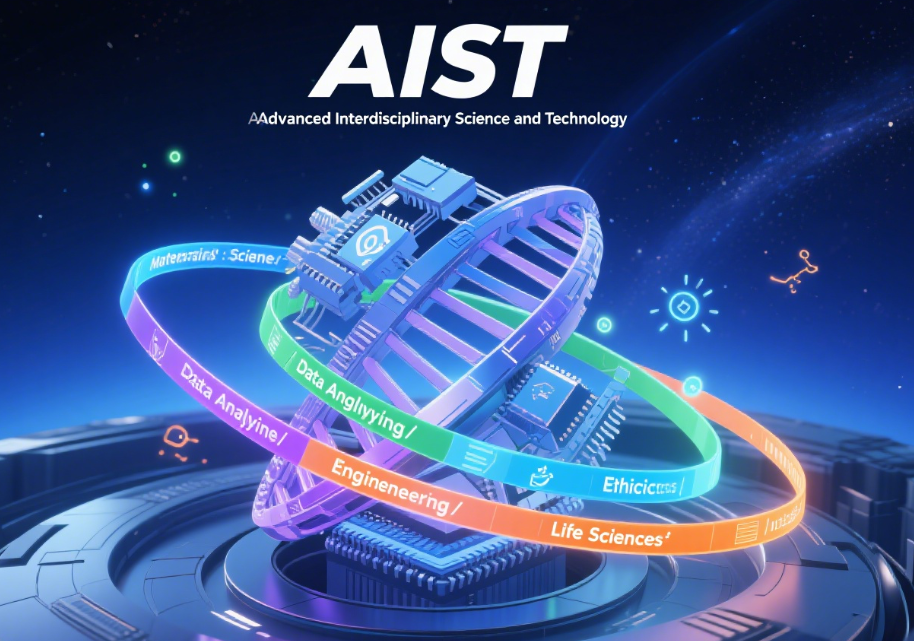
The launch of Advanced Interdisciplinary Science and Technology (AIST) responds to a critical paradigm shift in modern research, where the most profound scientific and technological challenges are inherently complex and transcend traditional disciplinary boundaries. This article articulates the foundational philosophy and urgent necessity for a dedicated platform fostering interdisciplinary synthesis. It argues that progress in frontier domains---from sustainable energy and bio-digital twins to AI-driven discovery---is increasingly contingent on the integration of diverse fields such as materials science, data analytics, engineering, ethics, and the life sciences. The article outlines AIST's role not merely as an archival publication but as a dynamic ecosystem designed to catalyze collaboration. It details the journal's commitment to a rigorous, multi-tiered peer-review process specifically tailored to evaluate the integrity and innovation of convergent research. Furthermore, it positions AIST as a vital conduit for translating integrated research into tangible societal impact, addressing global challenges through a holistic lens. The journal is presented as an essential agent in shaping the future of scientific inquiry, providing a structured and incentivized venue for the pioneering work that lies at the interfaces between disciplines.
Keywords: Interdisciplinary Science; Technological Convergence; Scientific Synthesis; Grand Challenges; Innovation; Collaborative Research; Knowledge Integration; Complex Systems; Artificial Intelligence; Machine Learning; Sustainable Energy; Translational Research; Peer-Review; Scientific Publishing; Research Ecosystem; Future Technologies.
The dawn of the 21st century has ushered in an era of unprecedented complexity in the scientific and technological landscape. The most pressing challenges confronting humanity---from climate change and sustainable energy to global pandemics, neurological disorders, and food security---are inherently multifaceted. They do not respect the traditional, siloed boundaries of academic disciplines. A problem like climate change is not merely a matter of atmospheric chemistry; it is inextricably linked to economics, material science, political policy, data analytics, social behaviour, and energy engineering. Similarly, the development of effective personalized medicine requires a confluence of genomics, computational biology, nanotechnology, ethics, and clinical practice. It is within this context of complex, systems-level problems that the critical need for a dedicated platform for interdisciplinary synthesis emerges. The birth of Advanced Interdisciplinary Science and Technology (AIST) is a direct and necessary response to this paradigm shift. Our journal is founded on the conviction that the next great leaps in human understanding and capability will not originate from within the deep but isolated wells of single disciplines, but rather from the fertile interfaces between them. AIST aims to be more than just another publication; it seeks to become the central agora for the exchange of ideas that defy conventional categorization, fostering the collaborative dialogues that are essential for true innovation.
The philosophy underpinning AIST is rooted in a historical recognition that interdisciplinary collaboration has been the bedrock of the most transformative scientific achievements. The field of molecular biology, for instance, was born from the convergence of genetics, biochemistry, and physics, exemplified by the discovery of the DNA double helix---a feat that required the crystallographic expertise of Rosalind Franklin, the biological intuition of James Watson, and the structural modeling skills of Francis Crick. Modern astrophysics relies on sophisticated computational models, advanced material science for telescope construction, and particle physics to understand cosmic phenomena. However, what was once an occasional, almost serendipitous occurrence must now become a deliberate and structured endeavour. AIST provides that structure. We move beyond the outdated model where interdisciplinary work is often an afterthought, squeezed into journals with a primary focus that can sometimes obscure the full value of the work. By establishing a venue whose very identity is defined by the fusion of fields, we actively incentivize researchers to think beyond their immediate technical surroundings, to seek out unusual partnerships, and to frame their research questions through a wider lens from the very outset.
AIST is strategically positioned to catalyze progress in several key frontier domains that are inherently interdisciplinary. In the realm of sustainable energy, solutions will not emerge from chemistry or engineering alone. The development of next-generation photovoltaics or solid-state batteries requires the synthesis of novel materials (materials science and chemistry), their integration into efficient systems (mechanical and electrical engineering), lifecycle and economic analysis (environmental science and economics), and the development of smart grid technologies for integration (computer science and data analytics). AIST will publish research that captures this entire value chain, providing a holistic view of the problem and its potential solutions. In healthcare, the convergence of technology and biology is creating the field of bio-digital twins. This involves creating dynamic, virtual models of human organs or physiological systems that can be used for drug testing, personalized treatment planning, and understanding disease progression. Building such a model is a quintessentially interdisciplinary task, demanding expertise in medical imaging, biomechanics, machine learning, software engineering, and clinical medicine. AIST serves as the ideal repository for such comprehensive studies, where the whole is fundamentally greater than the sum of its parts.
Furthermore, the rise of artificial intelligence and machine learning represents a transformative force that cuts across every scientific and engineering discipline. AI is not a standalone field but a powerful new methodology, a lens through which old problems can be re-examined and new ones solved. AIST has a vital role in documenting and accelerating this fusion. We will feature research that applies deep learning to decode the language of genomics, uses reinforcement learning to optimize chemical reaction pathways for synthesis, employs computer vision to analyse ecological satellite data for conservation efforts, and leverages natural language processing to mine centuries of scientific literature for overlooked connections. The journal will be a home for papers where the algorithmic innovation is driven by a deep domain-specific problem, and where the domain problem is, in turn, advanced by a novel computational approach. This symbiotic relationship between tool-makers and tool-users is essential for progress, and AIST provides the common ground for this dialogue, ensuring that advanced computational techniques are effectively translated into tangible advances across the scientific spectrum.
The operational ethos of AIST is built upon a rigorous and innovative peer-review framework designed to meet the unique challenges of evaluating interdisciplinary work. Traditional review processes, often conducted by specialists within a single field, can sometimes fail to appreciate the nuances and contributions of work that spans multiple domains. A paper might be judged excellent in its engineering merits but criticized for its biological assumptions by reviewers without the context to see the integrative intent. To overcome this, AIST will implement a multi-tiered review system. Submissions will be assessed by a diverse panel of reviewers, each representing one of the core disciplines engaged in the work. These reviewers will be tasked not only with evaluating the technical soundness within their area of expertise but also with providing commentary on the effectiveness of the integration itself. Additionally, a Senior Editor or an Associate Editor with broad interdisciplinary oversight will synthesize these reports, ensuring that the final decision reflects the work's composite value and innovation rather than its performance in any single silo. This process protects the integrity of the science while championing its integrative nature.
Beyond its function as an archive of high-quality research, AIST is conceived as a dynamic intellectual ecosystem. The journal will actively foster a global community of scholars, engineers, and thinkers who identify as interdisciplinary practitioners. This will be achieved through companion offerings such as commissioned review articles that map the convergence points between emerging fields, perspective pieces from leading scientists on future directions for interdisciplinary research, and editorials that stimulate debate on the methodology and philosophy of synthesis in science. We will also facilitate virtual special issues and conference partnerships that bring together diverse experts around a grand challenge theme, such as "The Science of Carbon Capture and Utilization" or "Engineering the Future of Neural Interfaces." By creating these focal points for discussion and collaboration, AIST transcends the passive role of a publication and becomes an active agent in the very process of knowledge creation, connecting people and ideas that might otherwise remain separated by institutional and disciplinary structures.
The societal impact of interdisciplinary science, and by extension of AIST, cannot be overstated. The translation of fundamental research into technologies and policies that benefit society requires a clear pathway from the laboratory to the real world. This pathway is inherently interdisciplinary. For example, the deployment of a new water purification technology in a developing region requires not only chemical engineers but also experts in public health, sociology, local economics, and sustainable design to ensure it is adopted, maintained, and effective. Research that encompasses these dimensions from the outset has a far greater chance of achieving meaningful impact. AIST will prioritize and highlight work that demonstrates this translational potential, providing a model for how science can and should engage with the world. By giving visibility to projects that successfully integrate technical and social dimensions, the journal advocates for a more responsible and effective model of research and development, one that is acutely aware of its human and environmental context.
For the individual researcher, particularly early-career scientists, engaging with AIST offers a unique opportunity for professional growth and differentiation. The modern research landscape increasingly values individuals who can communicate across domains, lead diverse teams, and articulate a broader vision for their work. Publishing in AIST signals to the academic and industrial community that an author is not confined to a narrow specialty but is capable of innovative thinking at the intersections. For readers, the journal acts as a crucial portal to understanding advancements outside their core expertise, presented in a context that highlights relevance and connection. A materials scientist can learn how their developments in nanoporous materials are being applied in carbon capture; a computer scientist can see how their new optimization algorithm is revolutionizing logistics in renewable energy networks. This cross-pollination of knowledge is essential for the intellectual vitality of the entire scientific community and for training the next generation of problem-solvers.
In conclusion, Advanced Interdisciplinary Science and Technology (AIST) is launched at a pivotal moment in the history of scientific inquiry. The challenges and opportunities of our time demand a new approach---one that embraces complexity, fosters collaboration, and dissolves the artificial barriers that have historically divided knowledge. This journal is our commitment to that future. It is a platform designed for the pioneers who are already working at the frontiers, for the teams that are weaving together disparate threads of knowledge to create stronger, more resilient solutions, and for the visionaries who see the interconnectedness of all things scientific and technological. We envision AIST becoming the definitive record of humanity's collective effort to understand and improve our world through synthesized intelligence. By championing rigor, innovation, and integration in equal measure, we aim to accelerate the pace of discovery and to ensure that the powerful engine of scientific progress is directed towards the most profound and pressing needs of our global society. The journey of synthesis is the next great adventure in science, and AIST is here to document, guide, and inspire it.